
Caput Lupinum
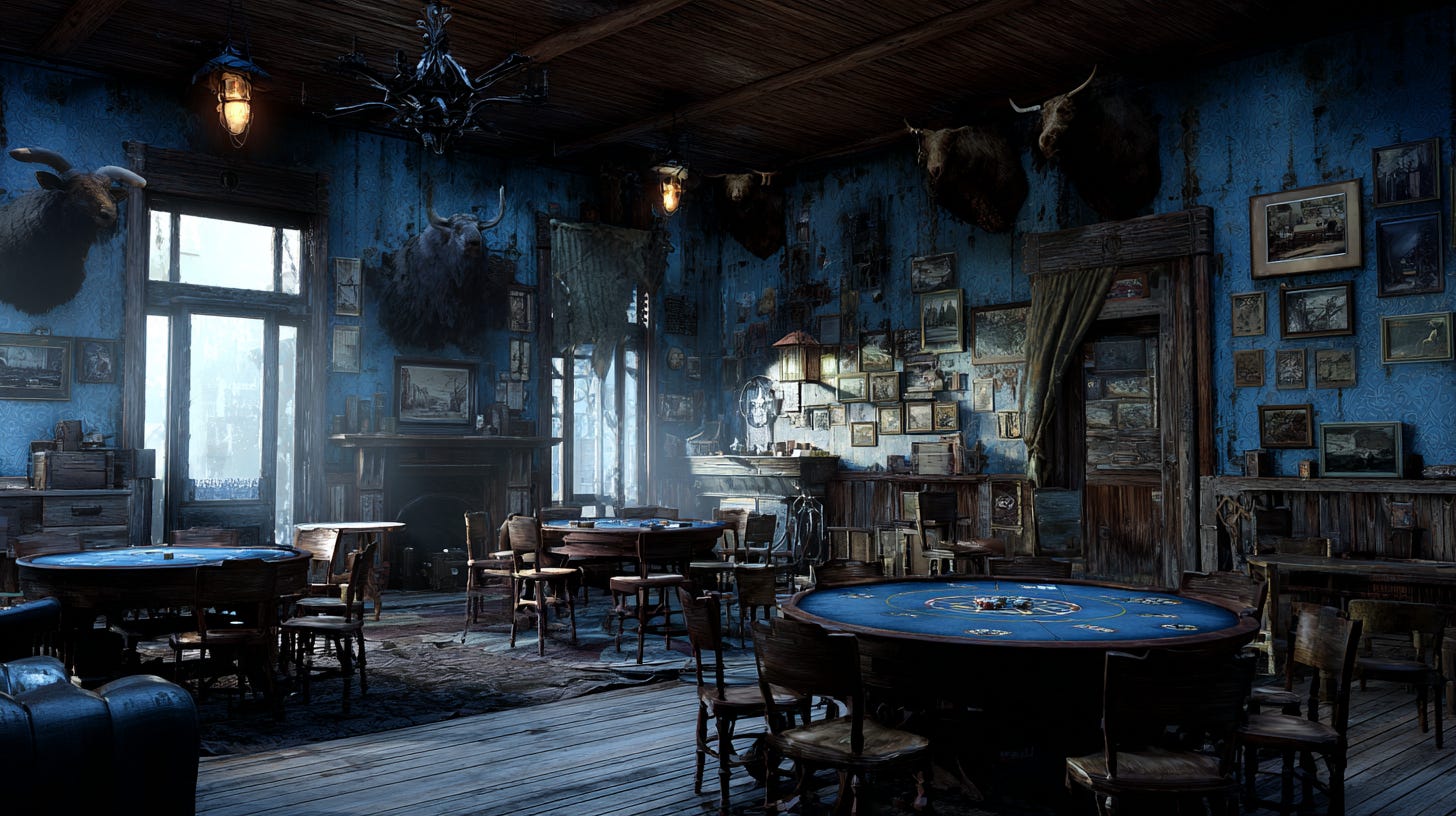
Even late at night, the Egregore Saloon was full, though the rugged men of that frontier town of Gulloth respected the hour, and drank in silence. Williams, the pianoman, had fallen asleep with his face on the keys. The barkeep, Leery, clinked his glasses quietly. There was no need for the patrons to ask for another drink; he knew when they were ready. The only sound was the low murmur of the gamblers, who were careful not to speak too loudly, for the men of the Egregore were as superstitious a bunch as anyone would find.
This night was a full moon, and hardly a lamp was lit in the saloon, for its beams shafted through the windows and the swinging door and lit the Egregore in silvery light. Thick shadows clung to the peeling blue wallpaper and lurked beneath the heads of pronghorn, bison and black bear which adorned the walls.
There was not a breath of wind on the plains in the black beyond past the swinging door, and it felt as if the Egregore were a lonely island on a vast, still sea, far from anything one might call civilization, and beyond that sea were worlds unimaginable. Perhaps the legendary Atlantis lay submerged somewhere on that plain. Perhaps the mythical world-serpent would rise up from that chaparral sea and do battle with the thunder. To ride those plains of the Saragossa territory was to feel what the great explorers felt— Columbus on the Atlantic when he saw the step pyramids of the Aztec rising out of the jungle mist, Marco Polo when he met the opulent yellow empires of the Orient. To live in Gulloth, on the edge of the world, men must be hardened, jaded, and ready to see wonders. These men were, and were continually surprised.
So every ear perked to the sound of yelling coming from the plains, rising up over the gallop of hoofs, though not every eye went to the window. Most carried on drinking and gambling, but now with heightened tension, and one hand ready for a quick draw of their pistols, should something unexpected come through the door.
“It’s the courier, Andrews,” said Leery the barkeep, pulling his head back in from the window. “Looks like he has two children with him.”
This caused a stir, and a scrape of chair legs on the wooden floor as the men rose to see. In the center of the saloon, one man stayed seated, and put his hand out to prevent his opponent from getting up. Jeremiah Mars was focused on his card game, and would have no interruption.
“C’mon, Jem,” said Candleman, his opponent.
Mars’ blazing blue eyes met Candleman’s, his thick eyebrows and thicker mustache all curling down into a frown. His face was hard worn, and hard set. That frown, for all the men of the Egregore knew, was permanent, carved like a statue or an idol of some perpetually displeased pagan deity, for whom there was no propitiation.
Candleman reluctantly sat again, downed his shot of whiskey, and the two continued the game, while Andrews the courier burst in through the swinging door with two children in his arms.
“What in God’s name’s going on, Andrews?” said Leery.
The courier was out of breath, and the children’s faces were blanched and horrified. Leery brought them water and what bread remained of the previous day, but the two children cowered even from the kindly barkeep.
“There’s been an attack,” the courier said gravely. “The Krieger settlement.”
There were other places in Gulloth that Andrews might have taken the children, other buildings, other people— though no one paid hardly any attention to anything but the Egregore Saloon, and anyone capable of helping was in attendance there. A murmur of dismay rippled among its patrons. Candleman watched over Jeremiah Mars’ shoulder intently.
“Sioux?” someone asked. “Or white men?”
As Leery pressed a shot into Andrews’ hand, the courier sighed. He downed the drink and said, “neither… Apparently.”
There were confused looks between the crowd, which turned expectant as they came to stare at the courier, waiting for him to elaborate.
“The children claim it was… werewolves,” Andrews said timidly.
“For Christ sake!” came the voice of Jeremiah Mars, tossing his cards onto the table. “If you’re not going to play, get up then!” he said to Candleman, who had continued to stare and pay no attention to his game. The latter wasted no time in leaping from the table to join the crowd around Andrews, leaving Mars finally alone at the table.
“What do you mean werewolves?” Candleman asked incredulously. “What could that mean?”
“Best ask them, if they’re calm enough now to tell ya,” said Andrews, gesturing to the children, who sat cross legged on the floor under blankets provided by the maid, Jewell, eating hard loaves with full bites.
The girl was older, about ten, and the boy eight. They were both blond, obviously German, even if they hadn’t been announced as residents of the Krieger settlement.
“Greta,” Andrews said, “tell them what you told me.”
“They were werewolves,” the girl said in accented English. “They walked like men but they had wolf faces. And it’s the full moon.”
Andrews turned back to the crowd, his face looking as surprised as if he’d just heard it the first time, as if begging for someone in the crowd to explain the anomaly. When no one did, he spoke.
“There were no other survivors. Just the children. Hid in a grain barrel.”
It took the baffled crowd some time to notice that Jeremiah Mars had now joined them, rising and walking soundlessly into the ring of men, taller than most, straighter and stouter. He stood right in front of the little girl, then crouched before her.
“Wolf faces?” he whispered, his voice gruff and smoke-blackened.
Greta nodded, matter-of-factly, not a hint of a lie or a fantasy in her face, though she recoiled somewhat from the voice and the breath of the man.
“Did these werewolves ride horses?” Mars asked.
Greta nodded again.
“What kind?”
She shrugged.
“And did they use weapons?”
“Yes,” said the girl.
“What kind?”
Greta’s face twisted as she clearly recalled the painful memory to mind. “Axes, and spears. Bow and arrow,” she said.
“Did they have firearms?” Mars asked.
“One did. Their leader.”
“A rifle? A repeating rifle? With a gold design on the stock?”
Greta thought, nodded again. Sorrow deepened on her face, her eyes welled with tears, but the girl was strong and she did not sob.
“What’s going on, Jem?” asked Cyril St-John, a young man new to town.
Jeremiah Mars did not answer. He had one final question which would confirm his suspicions about the werewolf attack.
“And did they do anything to the bodies after they… Did they meddle with them?” he asked.
Greta burst into tears and covered her face. Her younger brother spoke in her place. “They cut off the heads,” he said, with something of awe. “They didn’t scalp them. They took the whole head. They each wore skulls, hanging on their belts.”
“Thank you, Hans,” Andrews said as he placed his hand on the boy’s shoulder.
Mars rose to his feet, one hand going contemplatively to his chin, the other instinctively to the grip of his pistol in its holster. His frown deepened more than ever.
“Damnit, Jem, what’s going on? You know about this? These, these ‘werewolves?’” stammered Leery.
“I believe I do,” Mars half-growled. “Do any of you men remember one Titus Selinas?”
The crowd bore a mixed reaction. Most shook their heads at the name, but a few faces showed a sense of vague recognition.
“You should,” Jeremiah Mars responded, “all that money I’ve been betting— it’s his.” He waved toward his abandoned gambling table. “Not long ago, Selinas came through town. From where, only he knew.”
Mars grabbed an open bottle from Leery’s bar and poured himself a shot, to which no one objected.
“Said he went to college, studied… archeology. Anthropology, maybe. Had an affinity for ancient things. He was rich, Selinas. He didn’t come here seeking fortune, as so many of us. He was here to give his away. Never won a hand against me. He had a tell, Selinas— he would always rub his thumb and his middle finger together when he bluffed.”
Mars downed his shot as he demonstrated the motion.
“Get to the point, Jem. What’s it got to do with these werewolves?” said St-John.
“Selinas had a series of misfortunes. On the day he lost his last dollar to me, he rode off in a fury. Got ambushed by Injuns, lost his scalp. But that bastard survived, somehow, and from that day on he covered his head— with a wolf’s. After that, something in him changed. A more bloodthirsty and desperate man you’d never meet, like a rabid dog. Wanted all across Saragossa, and every other territory between here and Chicago. He never robbed, never stole. Only killed. And now, apparently, he’s come back to Gulloth.”
“With Indians? Who else would use axes and spears? I don’t understand, Jem,” said Leery.
“I said Selinas had an affinity for the ancient. He had an affinity for Injuns too. He had been studying some kind of clandestine rite known only by a small clan of degenerate Comanche north of Gulloth, called the Mintoka. He was surreptitious about it, but a gambler’ll say anything to distract you.”
This was the most anyone in the Egregore had ever heard Jeremiah Mars say. Before he finished, he had already donned his rumpled black hat atop his slicked hair, and pulled his long black coat over his broad frame. He was halfway to the door before anyone spoke.
“Where’re you going, Jem?” said Leery.
“We have to find this Selinas,” St-John said. “I’m coming with you, Jem. Anyone man enough here will follow.”
“What do we owe Krieger?” Williams the pianoman slurred. “The Germans chose to go out there on their own, for nothin’ but hate of us. If they stayed here, they’d be alive.”
“I don’t care who stays or comes,” said Mars. “The dog needs to be put down. That’s all.”
“Does anyone else volunteer?” asked St-John.
The saloon was silent once again, but outside a wind had picked up, and stirred the creaking door as if in invitation.
“We will defend Gulloth, and her springs,” Leery finally spoke, as if for every one of his patrons. “But we can’t very well go chasing every outlaw or Indian across the frontier.”
To this Mars nodded silently and tipped his hat. It was not duty nor honor nor courage nor bravery which led him out the swinging door of the Egregore Saloon into the vast night of the Saragossa frontier. It was guilt. Titus Selinas was a villain of his own making, at least in the eyes of Jeremiah Mars. Even a card player with an empty gold stake needed a clean conscience to sleep.
_
The frontier was as mysterious as it was deadly, doubly-so at midnight. Things were never quite where you wanted them to be, and even the courier Andrews, who knew the routes and the by-ways better than anyone, swore that sometimes the land changed, that its marks moved on him while he was away. And many men, who knew less than Andrews, swore by God that night time in Saragossa was an entirely different world than the day, as if Gulloth lay, like the Caesarea Philippi of old, upon the very gates of hell, which yawned open under the nightly curtain.
Mars checked his map by moonlight as he and St-John cantered down the one road that led west out of Gulloth.
“Eight miles to Krieger’s,” he said. “Make speed, we’ll be there in half an hour… assuming the way is clear.”
They spurred their horses and galloped into the plains. Chaparral stretched unbroken in every direction, lurking with moonlit shadows, crawling with snakes, spiders and scorpions. Coyotes yelped nearby, and strange nightbirds sang in dissonance with the insect drone. After a few miles they came upon crags and canyons, and if it had been day, they would have seen Mount Hermon rising in the north, and the forests at its foot. It was there, Mars recalled, that Selinas had said his research led him— to a strange clan of Indians who worshiped some ancient demon named only in the most remote Aztec legends, though was said to once rule the whole of the continent in the mists of the unrecorded past.
Wind howled in the canyon as the two men descended and raced its course, their horses galloping now with the spirit of a brave knight’s destrier of a by-gone age. The horses may have been noble, but neither of these men were knights. They were the product of a lawless land and an age without order, but even still they represented Man’s true end— to tame the wild, to establish order where there is none, and to deal God’s justice wherever it was needed, in spite of their own motivations.
“I didn’t know you were a fighter,” Mars’ gruff voice called to St-John over the wind and the galloping hoofs.
“I could say the same to you,” St-John replied. He was a much younger man, twenty-one at most, blond, bright where Mars was dark, sincere where Mars was cynical. “Besides shooting cheats and swindlers, I’ve never seen you touch your pistol.”
“Few men who’ve fallen to it have seen me touch it either. Bullets move faster than the eye.”
“I thought they called you Slowhand because you’re so indecisive at poker,” St-John replied.
“Where did you hear that name?” asked Mars.
“Some of the men around the saloon call you that. Me they call Saint. Looks like we both got ironic names.”
Jeremiah Mars had never spoken of his past to anyone in Gulloth, but a reputation like the one he’d earned in the Creek War was hard to outrun. To his surprise, he had found that when he traveled west into unknown lands he had been welcomed in each town to which he came. There were many dangers and terrors in Saragossa, and a quick gun was always valued.
The Krieger settlement was well hidden in the canyon, but ahead they could see the smoke of a large fire rising up in a column through the moonlit air, and the smell of smoke and death reached them half a mile off. Though it made the horses uneasy, the riders spurred them on all the faster, along the bank of the shallow river that had cut that canyon over countless centuries. A cliff of sheer red rock rose at their side, and its shadow swallowed them in darkness. Still, they pressed the sure-footed animals on at all speed.
Around a bend in the river they saw what was once the Krieger settlement— a smattering of shacks and barns along the river, set far back from its edge, a few of which were still aflame.
Mars halted the horses with a whoa and a gesture to St-John, some hundred yards from the settlement.
“These fires are new,” he said quietly. “They must still be nearby.”
“Anyone around woulda seen us coming,” said St-John. “No use in stealth now.”
Jeremiah Mars’ revolver was drawn and ready quicker than a blink, his blazing blue eyes scanning the fire-lit settlement for any movement. He noted none but the dance of shadows, but even from afar, he could see and smell the carnage. The bodies of the Germans had been piled in the center of the village, and their animals too had all been slaughtered— goats, sheep, donkeys, horses and chickens.
The two vigilantes spurred their horses on slowly and closed the distance, each hunched in the saddle with his weapon ready like a lion prepared to pounce. St-John’s face was that of horror, Mars’ of disgust. Each man had seen Indian raids on whites, and white raids on Indians, but neither had witnessed a scene of this depravity. It resembled more an animal attack— primal, base, thoughtless. The Germans were not only beheaded but torn limb from limb, flesh rent and ripped. Mars noted wounds from arrow and axe, but many resembled biting and gnawing. The livestock had suffered the same fate.
“I’m going to be sick, Slowhand,” said St-John.
“Keep an eye out,” replied the older man.
Mars dismounted and went to one of the collapsed, burning shacks, tearing out a broken plank to use as a torch. With it he examined the scene, seeing many tracks of horses and bare human feet and hands in the mud of the riverbank. Many appeared shrunken, deformed, or otherwise inhuman.
“Almost two dozen individual prints, by the looks of it,” he said. “They came from a pass up ahead, and left the same way… at least some did.”
“Jem!” St-John shouted.
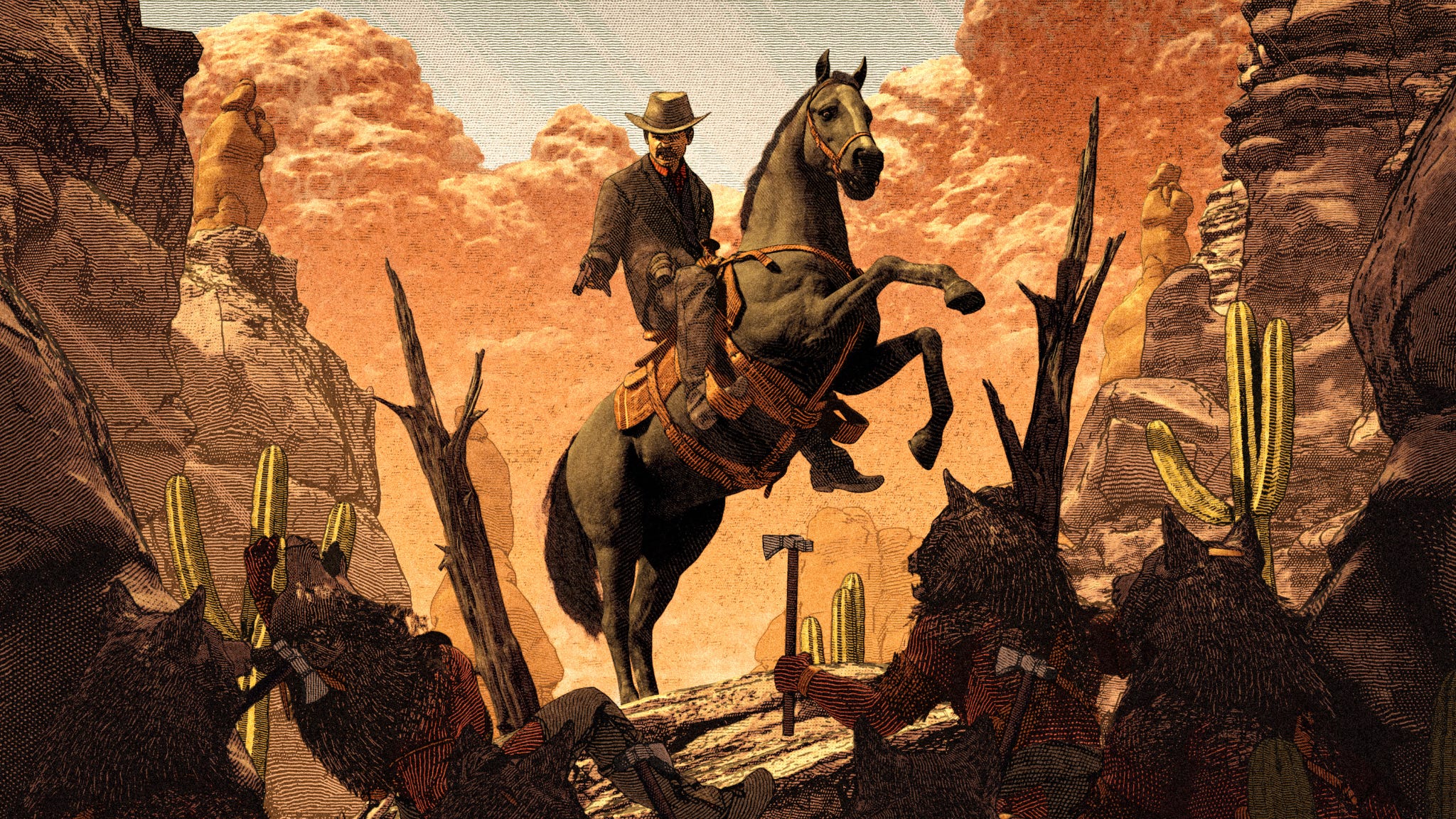
Mars whirled, pistol outstretched, and saw several shapes bounding across the river toward them. They were the shapes of men, loping on all fours like beasts, faces obscured beneath wolf masks, fur draped down across their bodies, human skulls bobbing upon their crude leathern belts.
One of the enemies released a bestial howl, but was cut short.
In one swift movement, Mars pulled the trigger three times, three bullets connected, and three bodies fell into the river.
Behind them now, in the midst of the village buildings, a commotion rose. St-John fired on the remaining men approaching from the river with his shotgun, while Mars turned in time to see several more ambushing from hiding places among the settlement. Some leapt upon his startled horse, which gave a bloodcurdling cry as they tore at its flesh and hacked at it with flint axes.
Mars aimed and fired, hitting the horse in its head to prevent a grislier fate. His final two rounds were sent at one of the men who had attacked it, both connecting square in the chest and collapsing him in a satisfying slump.
He turned back to the river, and saw St-John circling on his horse, firing on enemies who chased him like a pack of wild wolves.
There was nowhere to retreat or reload. Jeremiah Mars flipped open his cylinder, and his spent cartridges clinked to the stony ground. With instinctive speed he loaded the gun again from his bandolier, while the enemies from the village side closed in on him, tomahawks raised to strike.
They were only feet away when Mars closed the cylinder and pulled the trigger. Three more bangs dropped three more enemies directly at his feet. Jeremiah Mars did not flinch or retreat, lifting his boots only to avoid the pooling blood.
The remaining enemies were undeterred, and charged full speed upon him. Mars aimed calmly now, raising the pistol and aiming for the heads beneath those sick animal masks. He fired three times, and three more men fell dead. In an instant he tossed the cartridges and reloaded again from his belt.
Another bang echoed through the canyon, louder, and the ground at Mars’ feet exploded in a shower of dirt and shattered stone. He leapt back and searched for the source, as another rifle round whizzed just past his head.
High up on the ridge, he saw it. A lone figure, framed against the bright full moon, a black silhouette of man and beast. In his hand was a repeating rifle, whose elaborate stock glinted gold in the moonlight.
Titus Selinas raised the rifle again and fired.
Jeremiah Mars dove, and the round struck where he had stood a split second before. He rolled and tumbled across the corpses of the fallen, until he lay beside the body of his trusty horse, using it to shield him from the rifle fire, the animal serving him one last time even in death.
Meanwhile, St-John had dispatched the other pack, and called out to him now.
“Selinas!” he said. He raised drew his pistol and fired up the canyon cliff, and Titus Selinas ducked. “Jem, take my horse,” Cyril shouted. “You can meet him up the pass! I’ll cover you!” He leapt from horseback while still firing upon the rifleman above.
Jeremiah rose, took the reins, and flung himself upon the animal’s back with a shout of “hyah!” Before he was square in the saddle, it took off at full gallop toward the pass.
A bullet like a burning coal ripped through the flesh of Mars’ side. He did not cry out, but bit the reins between grinding teeth and hugged tight to the horse as it galloped in a craze. In a moment he had reached the pass, and turned the great beast up the slope to the ridge of the canyon.
When he reached the top, Titus Selinas was nowhere to be seen. He slowed the horse and checked his wound— the bullet had passed through his flank, and was not life threatening, but bled profusely. He threw off his black coat and tore his shirt into strips around his waist to staunch the blood, then he began to track his prey.
The tracks of a horse led away from where Selinas had fired on them, north toward the dark, uncharted woods which were the home of the Mintoka clan.
Mars spurred St-John’s horse on, wind on his bare skin, kicking up dust, scattering scrubland animals in his fury. He could not be far behind the murderer Selinas. The scrubland slowly faded into sloping rocks and pines, and ahead the hulking black shapes of the mountains swelled up the horizon, over the tops of the trees, wind-swaying and wanly lit.
He charged, no longer following a track, but driven by a mad rage and a hunter’s instinct into the thickening trees and the darkling forest. When his intuition nudged him, he slowed, and dismounted.
Ahead he heard inhuman yelps and howls stirring the pine boughs. Between the trees he saw the glow of a fire. He walked with a purposeful stride, no stealth to slow him, into the clearing where it burned.
There he found a sight even more disturbing than the slaughter in the village. A large bonfire back-lit a hideous, blasphemous totem, around which another half-dozen figures in wolf masks bayed and wailed on all fours like beasts.
The totem was comprised of blond-haired severed heads stacked upon a cairn of cleaned skulls. The worshipers prostrated before it between turns howling at the full moon which hung huge and low just above the mountain horizon. They did not seem to notice Mars’ presence, until they heard the click of his drawn hammer.
He stood on the edge of the clearing, aiming down at the men. They were naked but for their wolf heads, and their skin so drenched in blood that Mars could not tell a white from an Indian in the darkness, and did not know which was Titus Selinas.
One by one they turned to look at him, and slowly rose to their feet, though they remained hunched like animals.
For a moment, none moved.
Then Mars noticed something in the firelight— a slight movement in one of their hands. A nervous rubbing of the middle finger and the thumb.
He pulled the trigger and a bullet ripped into Selinas’ chest. Then hell truly opened on Jeremiah Mars.
Selinas charged him, undeterred by the wound, howling like a hellhound with blood spilling with every step, flying with the very wings of the under-fiends. Hot on his heels came the others. Mars fired a flurry of rounds at the charging demons. Each ate them and did not falter a moment.
With no time to reload, and in no shape to run, Jeremiah Mars dropped the gun and drew the long knife he kept on his pistol belt. The bloody Selinas fell on him first, taking him to the ground. They rolled and fought and struggled together, Selinas clawing and attempting to bite him with black teeth through his wolf head. Mars saw the eyes of the man through that mask. There was no humanity left in them.
He plunged the knife into Selinas, who hardly noticed, so he plunged it again, and again, and again, over and over until his body was a red ripped mass hardly recognizable as a man. Mars couldn’t say when the life faded from those inhuman eyes, because he felt some bestial trance himself, and soon the other men had fell upon him too.
To his surprise, a few of them began to gnaw and gnash at the corpse of Selinas, so sick in their bloodthirst that they cared not who sated it. Mars used the opportunity to kick and slash at the others, rise to his feet, retrieve the pistol. He loaded half a dozen rounds. He fired.
This time, he aimed once more at their heads.
The last of the wolf men fell face down on their cannibalized leader’s mangled corpse. Mars collapsed too, in exhaustion, in revulsion at the sight, and from his own blood loss. There he sat for some time alone in the ungodly grove, until he heard the footsteps of the breathless St-John.
“Jem!” the young man yelled, coming to where he sat.
“I’m okay,” Mars replied gruffly.
“Like hell you are, Slowhand,” he said. “I found the horse. Let’s get you outta here quick.”
“Not yet,” groaned Mars, as Cyril helped him to his feet. Together they went to the bloody heap of bodies. “We need to get rid of these men, burn them.”
He reached down to rip off the wolf head mask from the man that had once been Titus Selinas, but it did not budge. He winced, too weak to pull harder.
“Help me with this, Saint,” he said.
St-John put both hands on the mask and pulled, tearing flesh as he did so. But hardened men gasped at what was beneath.
Selinas’ head bled as though he had just been scalped a moment ago, as if the mask had grown where his own skin had once been. Perhaps it was a trick of the moonlight, or the dancing flames of the heathen bonfire, but there seemed to be something bestial even in the man’s true face, as if he had somehow begun to grow a snout, as if his teeth were too long, too sharp.
They picked him up and heaved him into the flames, along with the rest of his pack.
“These heads we need to take back, bury them with the bodies of the Germans,” Mars said of the blasphemous totem.
“By God, Jem, can’t it wait ‘til morning?”
“By morning they’ll be picked by ravens. We take them tonight.”
“I never seen anything like it, Jem. Never in my life.”
This was a phrase uttered so often among the men of the Egregore Saloon, in the town of Gulloth, in the Saragossa wilderness, that it had nearly lost meaning for Jeremiah Mars, a man who was prepared for everything, and was continually surprised. Perhaps in his short time in the town, he had begun to forget what the world was supposed to be like. Yet, as he dragged out of the woods that unholy effigy, dredged up out of the black crypts of pagan history by a down-on-his-luck anthropologist, he wondered if the world of brick and pavement, of structure, of civilization was the real aberration. He wondered if man was truly more than a beast, truly made in the image of a higher order. He believed so. He had staked his life on it. And yet, when he had slain Titus Selinas, he had felt the beast rise up in him, and wondered for a split moment if it could have been him howling on all fours at the full moon. Yet he had taken no satisfaction in the killing, and had felt somehow as though Selinas had escaped true justice.
And if there was one thing Jeremiah Mars was certain of, it was that this adventure would not allay his conscience.